Showing posts with label Digg. Show all posts

Thursday, February 28, 2013

Posted by Desitube | File under : , , , , , ,

At left, a view of downtown Beijing on a clear day. At right, the same view on Wednesday night, U.S. east coast time. (Photo by Bill Bishop)
At left, a view of downtown Beijing on a clear day. At right, the same view on Wednesday night, U.S. east coast time. Click to enlarge. (Photos by Bill Bishop)
China’s air pollution has been bad lately. Really, really bad. We’ve posted photos of it before, but the above shot really drives home how severe this has gotten.
Both photos were taken in Beijing by Bill Bishop, who runs an excellent all-things-China e-mail newsletter called Sinocism (go subscribe). The photo on the left shows his view on a clear day. That tall building is the mammoth China World Trade Center Tower III.
On the right is a photo of the same view, taken late on Wednesday, U.S. East Coast time, or about 8 a.m. Beijing time. The 81-story skyscraper is all but invisible, shrouded by a layer of pollution so dense that even close-up objects are a blur.
Air pollution is gauged by a measurement called particles per cubic meter of air, sometimes abbreviated PM2.5 because it measures particles smaller than 2.5 micrometers wide. The higher the PM2.5 rating, the more dangerous particles are in the high, the worse the air is for your health.
To give you a sense of scale, there’s a big controversy in Utah right now because the PM2.5 air pollution in Salt Lake City has sometimes hit as high as 69. That number is considered unhealthy. According to the Environmental Protection Agency, even adults should avoid all outdoor activities if the count hits 300. In Beijing and other Chinese cities, the air pollution rating can spend days hovering around 500.
The pollution has been largely sustained for several weeks now, getting so bad that even Chinese state media is starting to call for the country’s leadership to reconsider its at-all-costs emphasis on economic growth.
Here’s a larger version of the photo, not that you can make much out in it:
Beijing on the morning of Feb. 28, local time. (Photo by Bill Bishop)


Wednesday, February 27, 2013

Langer lines map out the pattern of forces within the skin but nobody knew what caused them. Until now.
The mechanical properties of skin are important factors in everything from forensic science to razor blade design. And yet studies that have actually measured these properties are few and far between, most research in this area being done on synthetic or animal skin. 
Today, Aisling Nı Annaidh at University College Dublin in Ireland and a few pals right this wrong with a detailed analysis of the mechanical properties of 56 pieces of skin removed from dead humans. In the process, these guys have settled a debate about the nature of skin strength that has puzzled anatomists since the 19th century.
The first detailed study of skin strength was carried out in the 1860s by Karl Langer, an Austrian anatomist working in Vienna. He mapped the natural lines of tension within skin by puncturing the skin on a cadaver with a circular tool and then measuring the shape of the resulting hole.
The tension within the skin makes these holes elliptical in a direction parallel to the tension. Consequently, a simple measurement of the orientation of these ellipses allowed Langer to map out lines of force in the skin over the entire body. Today, these lines are known as Langer lines.
But Langer lines raise an important question. Are they simply the result of forces that arise when the skin is attached to the body or is there some anatomical reason for the pattern, some structure in the skin that causes the forces to align in this way? 
One line of thinking is that collagen fibres become aligned in certain directions and these therefore determine the direction of the Langer lines. But nobody has ever compared the structure of collagen fibres to the direction of Langer lines. 
Until now. Annaidh and co took 56 samples of skins from the backs of cadavers donated to medical science. They then measured the tensile strength of this skin and worked out the structure of collagen fibres within it using a collagen staining technique.
Finally, they compared the pattern of collagen fibres to the generally accepted map of Langer  lines.
Their conclusion is straightforward. “There is a definite correlation between the orientation of Langer Lines and the preferred orientation of collagen fibres,” say Annaidh and co.
That conclusion and the other mechanical properties that the team measured will be useful in various fields such as cosmetics, surgical simulation, forensic pathology and impact biomechanics.
And this not being the type of experiment that is done very often, the results will no doubt be used for decades to come.
Ref: http://arxiv.org/abs/1302.3022 :Characterising the Anisotropic Mechanical Properties of Excised Human Skin

The real Frank Dux reveals details of the classic fight movie 25 years after Jean-Claude Van Damme took on the role.
 posted on February 27, 2013 at 12:42pm 

Posted by Desitube | File under : , , ,
An all-expenses paid trip to Australia, a gift certificate for a facelift, and oh yea, a bottle of Windex. These are just some of the items celebrities received on the film industry’s biggest night of the year, and Uncle Sam will get his piece.
Despite the 2013 official Oscar gift bag being worth a reported $47,000 this year, celebrity lifestyle expert Dorothy Cascerceri says that number is tame compared to the value of swag filling the bags in the past.
“In years past, the gift bags have totaled up to $90,000. I think everyone is scaling back because of the economy. But frankly, do you think a celebrity will miss that? Definitely not.”
The facelift gift certificate is worth $5,000, she says, and the trip to Australia rings in at $30,000, making up for the bulk of the gift bag’s price. In addition to the Windex, which Cascerceri says is an odd inclusion, celebs also received hair ties that double as bracelets and Leeza Gibbons’ book, Take 2: Your Guide to Creating Happy Endings and New Beginnings
“There have been trips [like the Australia package] in the past,” she says. “Celebrities don’t fly coach, so it’s a big-ticket item.”
But don’t expect to catch Jennifer Lawrence and George Clooney on a plane to down under filling the time reading the self-help book. Cascerceri says most celebrities re-gift the goodies.
“Most celebrities have enough money to go to Australia, so they gift them to the people around them, like their hair and makeup people.”
But all that swag comes with a price to Uncle Sam; Cascerceri likens it to winning a prize on Jeopardy.
“It’s like winning a car on a game show,” she says. “You are able to drive the car away, but it’s not for free.”
The gift bags get taxed at the total cost of the full package, according to Certified Public Accountant Dan Roman of Liberty Tax in Detroit. So the full $47,000 will be taxed at both the state level of 13.3% in California, where it was issued, as well as at the federal rate of 39.1%, assuming the recipients are in the top income tax bracket.
“The IRS indicates these things as payment for something when celebrities receive these gifts,” Roman says.
The  tricky part of the scenario is in gifting the goodies to someone else. In this case, celebrities are supposed to issue the IRS and the person they are giving it to a 1099, so the government can track it. The celebrity will get taxed on it and it can be seen as a gift or additional income for the secondary recipient, according to Roman.
And finally if the A-lister is feeling charitable, and donates the Oscar goody bag, they can claim the charitable deduction and pay zero taxes on the gifts inside, he says.


'ARE YOU LOST, LITTLE GIRL?'
Sh*t People Say To Female Journalists->

Posted by Desitube | File under : , , ,

IT’S THE ECONOMY

Are We in Danger of a Beer Monopoly?

Illustration by Jasper Rietman
Every day, the Web site BeerPulse tries to list every single new beer available in the United States. And that’s harder than you might imagine. Recently, the site posted Cigar City’s Jamonera Belgian-style Porter, Odell Tree Shaker Imperial Peach IPA, as well as a rye lager, a cherry blossom lager and a barley wine. And the list goes on, and on. In 1978, there were 89 breweries in the United States; at the beginning of this year, there were 2,336, with an average of one new brewery per day. Most of them are tiny, but a handful, like Sam Adams and Sierra Nevada, have become large national brands. At the same time, sales of Budweiser in the United States have dropped for 25 consecutive years.
Deep thoughts this week:
1. Economists use game theory to predict which mergers are good for consumers.
2. Expect many more of them in the near future.
3. One day soon, the Justice Department might be the least of megacompanies’ worries.

It’s the Economy

Adam Davidson translates often confusing and sometimes terrifying economic and financial news.

So I was surprised to learn that the Justice Department is worried that Anheuser-Busch InBev, the conglomerate that owns Bud, is on the cusp of becoming an abusive monopoly. In January, the department sued AB InBev to prevent it from buying the rest of Mexico’s Grupo Modelo, a company in which it already carries a 50 percent stake. The case is not built on any leaked documents about some secret plan to abuse market power and raise prices. Instead, it’s based on the work of Justice Department economists who, using game theory and complex forecasting models, are able to predict what an even bigger AB InBev will do. Their analysis suggests that the firm, regardless of who is running it, will inevitably break the law.
For decades, they argue, Anheuser-Busch has been employing what game theorists call a “trigger strategy,” something like the beer equivalent of the Mutually Assured Destruction Doctrine. Anheuser-Busch signals to its competitors that if they lower their prices, it will start a vicious retail war. In 1988, Miller and Coors lowered prices on their flagship beers, which led Anheuser-Busch to slash the price of Bud and its other brands in key markets. At the time, August Busch III told Fortune, “We don’t want to start a blood bath, but whatever the competition wants to do, we’ll do.” Miller and Coors promptly abandoned their price cutting.
The trigger strategy, conducted in public, is entirely legal. In fact, it’s how airlines, mobile- phone companies and countless other industries keep their prices inflated. Since that dust-up in the late ’80s, the huge American beer makers have moved in tandem to keep prices well above what classical economics would predict. (According to the logic of supply and demand, competing beer makers should pursue market share by lowering prices to just above the cost of production, or a few cents per bottle.) Budweiser’s trigger strategy has been thwarted, though, by what game theorists call a “rogue player.” When Bud and Coors raise their prices, Grupo Modelo’s Corona does not. (As an imported beer, Corona is also considered to have a higher value.) And so, according to the Justice Department, AB InBev wants to buy Grupo Modelo not because it thinks the company makes great beer, or because it covets Corona’s 7 percent U.S. market share, but because owning Corona would allow AB InBev to raise prices across all of its brands. And if the company could raise prices by, say, 3 percent, it would earn around $1 billion more in profit every year. Imagine the possibilities. The Justice Department already has.
Representatives from AB InBev, however, have stated that the potential Corona acquisition is less about dominating the dwindling (albeit still $90 billion per year) U.S. beer market and more about a larger, global strategy. In that regard, AB InBev has been on quite a roll. The Brazilian firm Companhia de Bebidas das Américas, or AmBev, was born in 1999 around the concept of using innovative technology and managerial efficiency to disrupt the competition and channel the profits into buying them out. The company swallowed up several Latin American firms; in 2004, it merged with the Belgian giant Interbrew; in 2008, the new conglomerate, InBev, took over Anheuser-Busch. Along the way, it also picked up China’s third-largest brewer and the Canadian beer company Labatt.
We are still in the very early stages of what appears to be a global version of the scale-based consolidation we’ve seen in the United States over the past century. Before Prohibition, beer was largely a regional business, with thousands of small breweries serving markets often defined by city blocks. Until fairly recently, retail, food manufacturing, banking and countless other industries were also largely the domain of local or regional firms. And while in recent decades companies have scrambled to command international markets, the global fights have largely been over dominance of the United States, Western Europe and Japan.
But the goal of the Grupo Modelo merger, the company has stated, is to gear up for the big beer fight of the 21st century. As the traditional beer markets of the United States, Europe and Japan age, the most lucrative markets will be in China, India, Latin America, Eastern Europe, the wealthier countries of Africa and other places where, every single day, millions of young consumers will buy their first legal beer. On this front, AB InBev is already facing staunch competition from Denmark’s Carlsberg, Britain’s SABMiller and Japan’s Asahi. It’s not exactly worried about Sam Adams and Sierra Nevada.
These firms are among the many preparing for a global market several times larger than any that has ever existed. This helps explain why we have seen so many mergers in the past few months. The Justice Department recently approved the marriage of Penguin and Random House, and is expected to do the same with American Airlines and US Airways. Office Depot and OfficeMax are planning a merger of their own. These megamergers, however, do not inevitably create destructive monopolies. Carl Shapiro, the former chief economist at the Justice Department, told me that large mergers improve competition. Together, Penguin and Random House may be able to better stave off Amazon; American Airlines and US Airways can contend with Delta. Similarly, Office Depot and OfficeMax, once merged, may finally be large enough to really scare Staples. Fear, Shapiro says, is the key. Markets work best, he says, when “everyone has to watch their back.”
Shapiro admits that the Justice Department has lagged behind the work of many economists, and has been complicit in our fear of large mergers.(In some key decisions, like the 1962 Supreme Court ruling to block the merger of Brown Shoe and the Kinney Company, courts hurt consumers by preventing corporate efficiency.) But economic forecasting has improved since then, Shapiro says, and become more flexible. After AB InBev executives tweaked their Grupo Modelo acquisition plans, so not to affect their domestic interests, the Justice Department started to rerun the numbers. They’ll issue an opinion soon.
Over the coming decades, though, the opinion of American government officials might not matter quite so much. China’s National People’s Congress approved its first antimonopoly law in 2008, which, many economists fear, could be used to block foreign competitors and to promote local giants. India’s version, which went into effect in 2009, is even less clear. It’s quite possible that the true monopolistic battles of the 21st century will not be among massive corporations but among the self-interested governments. We can only hope that they don’t engage in a trigger strategy of their own.
Adam Davidson is co-founder of NPR’s “Planet Money,” a podcast and blog.

The following is an article from Uncle John's Unstoppable Bathroom Reader.
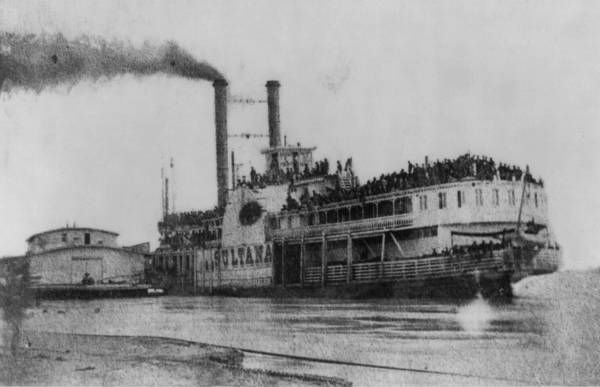
Few people know about the Sultana, despite the fact that it suffered the worst maritime disaster in U.S. history. For some reason, it is almost completely ignored by history books. Here's the tragic story.

 HEADING HOME

The Civil War was finally over. It was April 1865, General Robert E. Lee had surrendered; Abraham Lincoln had been shot; and Confederate president Jefferson Davis had been captured. After four years of bloodshed, the war-torn nation was ready to start the process of healing and rebuilding. The first order of business was to get the weary troops home.

Captured Union soldiers were being released from Confederate prison camps. Thousands amassed along the Mississippi River seeking passage on one of the many steamships making their way upriver to the north.

One such riverboat was the Sultana, a state-of-the-art side-wheeler that had been built for transporting cotton. But now her cargo was people. By law, she was allowed to carry 376 passengers and a crew of 85, and the ship's captain and owner, J.C. Mason, had a reputation as a careful river pilot. But in the end, the money he stood to make from the Union government for transporting extra troops was too tempting to pass up: $5 for each enlisted man and $10 per officer.
A SETUP FOR DISASTER

The Sultana left New Orleans on April 21 carrying a small number of passengers, about 100, and headed north. Each time she stopped, though, the ship took on more troops. The men who boarded were weak, tired, and homesick. After spending months or even years in brutal prison camps, the only thing they wanted to do was get back to their families.

On April 24, the Sultana made her regular stop in Vicksburg, Mississippi, to take on more passengers. Captain Mason docked the ship to find thousands of soldiers waiting there. Under normal circumstances, the ship would have made a brief stop, allowing the prescribed number of passengers to board, and then departed. But one of the ship's main steam boilers had sprung a leak and needed to be repaired. 

First of all, Captain Mason made the decision to have a piece of metal welded over the leak to reinforce it (which took less than a day) instead of having the boiler replaced (which would have taken three days). While the boiler was being prepared, the waiting soldiers did everything they could to muscle their way onto the ship. Bribes were paid, and more and more men packed on. When the repairs were completed, Mason was eager to get underway, so he broke another rule. He let all of the passengers get on board before their names were logged in. Result: the ship was overloaded and no one on shore had a complete or accurate copy of the passenger list.

When an Army officer raised his concerns, Mason assured him that the Sultana was a competent vessel that could more than carry the load. "Take good care of those men, " the officer told him. "They are deserving of it."
THE MIGHTY MISS

Four years of war had been hard on the series of levees and dikes that control the flow of the Mississippi River. The spring of 1865 saw heavy rains, which, combined with winter snowmelt, caused the river to rise to flood stage. By April it was several miles wide and the icy current was much stronger than usual.

But the Sultana was solid and Captain Mason an able river man. As the ship trudged slowly upriver, she made a few more scheduled stops, picking up even more men at each one. The huddled passengers filled every bit of space on the 260-foot-long vessel -the bottom hull, the lower decks, the cabins, the pilothouse, and the hurricane deck on top. Yet even though the soldiers were tired and packed in like sardines, their spirits were high. They sang songs, told war stories, and shared their plans for when they finally got home …unaware of the disaster to come.

On the cool night of April 26, 1865, the Sultana disembarked from Memphis around midnight, carrying an estimated 2,300 people -six times its capacity. There were only two lifeboats and 76 life preservers on board.

HELL AND HIGH WATER

At around 2AM, the overloaded Sultana had made it nine miles north of Memphis when her weakened boiler could take no more. It exploded. The other two boilers went in quick succession.


The tremendous blast split the ship in two. Burning hot coals shot out like bullets. The horrified passengers were jarred awake, some sent hurtling through the air into the icy water, others scalded by the tremendous blast of steam. Still others were trapped on the lower decks to either suffocate, burn, or drown. The men on the top decks had a choice -albeit a dismal one: stay and face the spreading flames or try to swim to shore, more than a mile away in either direction.

One survivor remembered, "The men who were afraid to take to the water could be seen clinging to the sides of the of the bow of the boat until they were singed off like flies." Other who had waited too long on the hurricane deck were crushed when the two large smokestacks collapsed on them. Others slid down into the hottest part of the fire when the burning deck gave away.

Shrieks and screams pierced the night, as did the crackling of flames and the booms of small explosions. But the loudest of all was the hissing sound as sections of the flaming steamboat sank into the water. Another survivor described it like this:
The whole heavens seemed to be lighted up by the conflagration. Hundreds of my comrades were fastened down by the timbers of the decks and had to burn while the water seemed to be one solid mass of human beings struggling with the waves.
What was left of the Sultana drifted downstream until finally banking on a small island in the middle of the Mississippi River. The ship's broken, burning body then slowly disappeared into the dark water.

DAWN OF THE DEAD

As first light rose on the river, the devastation was overwhelming. Hundreds upon hundreds of bodies were floating down the Mississippi. Dotted between the corpses were dazed survivors floating on makeshift rafts of driftwood and ship parts. Some sang marching songs to keep their spirits up. Others just floated silently among the carnage.

All the way to Memphis, men -alive and dead- were washing up on shore. Barges and other steamships were dispatched for search and rescue. At least 500 men were treated at Memphis hospitals; 200 of them died there. Because the passenger list went down with the ship, no one knows for sure how many lives were lost that night, but most estimates put the number around 1,700 -including captain Mason.
Sultana survivors at a reunion in 1920.


INTO THE DUSTBIN OF HISTORY

So why is the Sultana disaster such an unknown part of U.S. history? Mostly because of timing. After the bloodiest war in U.S.history, the nation was largely desensitized to death. What was another 1,700 in the wake of hundreds of thousands of casualties? The newspapers were full of articles about the end of the war, a new presidency, and a nation rebuilding. On the day before the disaster, the last Confederate army had surrendered and John Wilkes Booth had been captured. The story of the sinking of the Sultana was relegated to the back pages.

Another reason for the minimal coverage was that it was an embarrassing story. A lot of people -from the ship's captain to the army officers in charge of boarding- had failed miserably at their jobs. The Army was not anxious to publicize such a horrible dereliction of duty.

But the fact remains that the explosion and sinking of the Sultana was -and still is- the worst maritime disaster in U.S. history. Her bow is still lying on the muddy bottom of the Mississippi River as a sad memorial to the men who never made it home.
___________________
The article above was reprinted with permission from Uncle John's Unstoppable Bathroom Reader.
Since 1988, the Bathroom Reader Institute had published a series of popular books containing irresistible bits of trivia and obscure yet fascinating facts. If you like Neatorama, you'll love the Bathroom Reader Institute's books - go ahead and check 'em out!

Sometimes going to prison can be an unfortunately rational health care decision.


A 41-year-old man who had been incarcerated came to see me recently. While in prison he got in a fight, which led to a CT scan. He hadn't broken anything, but the scan did surreptitiously show two aneurysms. Both were in his hepatic artery (the artery that feeds his liver). 
They were small, so the doctors kept an eye on the aneurysms without doing surgery. But the next time they checked, they had nearly doubled in size. 
He was referred to a surgeon at a different hospital than the one I work at, and underwent an angiogram, to see the aneurysms better. The surgeons there said that he was sure to die if they did not intervene, and that they should schedule a surgery within the coming weeks.


Fortunately for him (or so he thought) he was released from prison one week later. When he returned for his pre-op visit, though, he was told that since he'd been released from prison, he no longer had insurance to cover the operation.
He asked what he should do. The told him to figure out how to get insurance.
I think this patient would be the first to admit that he had made numerous mistakes in his life. And he had paid a significant price for them. He truly was ready to make changes, to live positively, to help those around him. But, not knowing what else to to, it occurred to him that the easiest way to get the care he needed would be to get back in prison.
The next week, he went to a department store and, making sure a security guard saw him, pocketed some moisturizing cream. He looked up at the guard, smiled, and walked out.
After he was arrested, he wrote a note to the judge saying that he needed to get back into prison for a year, to get an operation. He told me the judge said "I'll give you 14 months, go get your surgery."

                                                                                                     ****

recent study showed that out of over 2,300 bankruptcy filers in the United States in 2007, greater than 60 percent of them were caused at least in part by medical illness. It is hard as a physician to watch patients and families who are scared, facing these difficult times in their lives, also knowing that they are going down a pathway to bankruptcy from which they may never recover.
There are those that feel that everyone should have full medical care provided regardless of age or socioeconomic status, and a single-payer (government) system would be best suited for that. Others argue that this would be both too expensive and too inefficient, and would lead to even higher costs than already exist for healthcare. Perhaps costs could be better controlled if patients had skin in the game, and had to make choices about what care they would like with some responsibility for paying for the treatment they receive.
In my own field, transplant surgery, patients have to be insured to be eligible for transplantation. This is generally not a problem for patients with kidney failure, as anyone with a work history becomes eligible for Medicare regardless of age or disability status.
Any patient with end stage liver disease who does not have insurance (and is not eligible for Medicare) has the option of trying to qualify for state-funded Medicaid (which includes demonstrating both poverty and disability), stealing moisturizing cream from a department store, or dying. 
I have personally taken care of a number of patients who did not want to put their family through the formidable weight of bankruptcy and opted for number three. 
Even our veterans, who do have coverage through the VA systems, only have access to transplantation at five centers in the country. They are also held to stricter criteria about who is eligible for transplantation than those outside of the VA system. My general sense is the access to transplant is much less for vets than for those outside this system. Some of them might be better off going to the department store.
The Affordable Care Act will address some of these issues, at least striving to provide some sort of coverage to everyone, although given the resistance of many states and unclear plan regarding expanding Medicaid -- which as a system does require patients to be essentially bankrupt -- there will still be large gaps in coverage in many of the patient populations that may need it most.
***
Some say that many patients with liver failure have done it to themselves -- that their disease is the result of choices they made in their lives (including previous drug use that led to hepatitis C, or alcoholism). These diseases don't represent all patients that need liver transplant, but certainly a significant portion. But most people who think this way aren't the ones who have to go to a patient's room, look into his scared eyes while he is surrounded by his spouse and children, and tell him that he is going to die in the next few months and there is nothing we can do. "Actually, we could totally save you and give you another decade or two of life but unfortunately you don't have insurance, and it's your own fault, anyway."

When I was growing up, my dad (who went back to medical school when I was in third grade) used to regale my brothers and me with stories from the trenches during dinner. One story in particular stands out. The patient needed surgery, but he had no insurance. So the plan that my dad and his team hatched (sorry dad, hope you don't get nailed for this) was to have this patient go in front of the emergency room at noon that Monday (a convenient time for everybody), collapse, and complain of acute abdominal pain. He was quickly whisked into the emergency department, deemed to have an acute abdomen, and taken to the operating room for definitive surgery. As long as it was an emergency, the hospital had no choice but to offer the treatment. 

With the current shortage of organs, though, a patient in need of a transplant who did this same thing wouldn't be so lucky.
***
I should tell you how the case of the lotion thief ended. I took him to the operating room, removed his two aneurysms, and replaced his hepatic artery and its right and left branches with reversed internal iliac artery from his own leg. Surgery went great, and he recovered nicely. I just hope he stays in prison long enough to get some follow-up care.